Learning to Feel the Future:
DreamTacVLA for Contact-Rich Manipulation

Guo Ye, Zexi Zhang, Xu Zhao, Shang Wu, Haoran Lu, Shihan Lu, Han Liu
TL;DR. DreamTacVLA grounds VLA models in contact physics by aligning seeing with feeling and predicting future tactile signals, achieving up to 95% success on contact-rich manipulation.
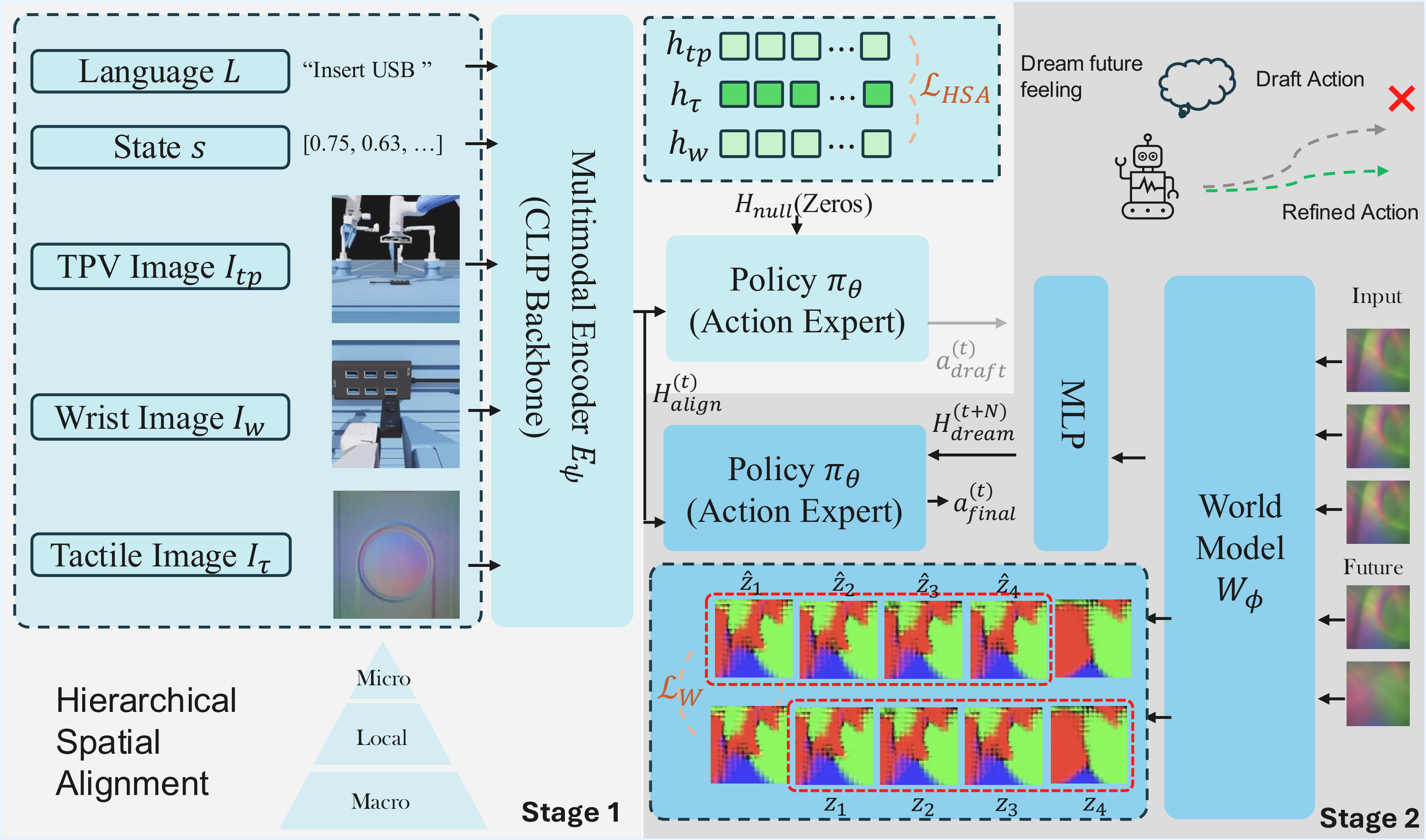
The Think–Dream–Act loop. The policy drafts an action, the tactile world model dreams its contact consequences, and the policy acts on a refined command.

Abstract

Vision-Language-Action (VLA) models have shown remarkable generalization by mapping web-scale knowledge to robotic control, yet they remain blind to physical contact. Consequently, they struggle with contact-rich manipulation tasks that require reasoning about force, texture, and slip. While some approaches incorporate low-dimensional tactile signals, they fail to capture the high-resolution dynamics essential for such interactions.

To address this limitation, we introduce DreamTacVLA, a framework that grounds VLA models in contact physics by learning to feel the future. Our model adopts a hierarchical perception scheme in which high-resolution tactile images serve as micro-vision inputs, coupled with wrist-camera local vision and third-person macro vision. We first train a unified policy with a Hierarchical Spatial Alignment (HSA) loss that aligns tactile tokens with their spatial counterparts in the wrist and third-person views. We then finetune the system with a tactile world model that predicts future tactile signals. Across contact-rich manipulation tasks, DreamTacVLA outperforms state-of-the-art VLA baselines, achieving up to 95% success.

Method

1

Hierarchical Spatial Alignment

We align macro (third-person), local (wrist), and micro (tactile) views into a single latent space using an InfoNCE-style loss over activated tactile pixels and their visual counterparts.

2

Tactile World Model

A frozen V-JEPA2 backbone, finetuned on our tactile data, predicts future tactile embeddings conditioned on a draft action — an implicit physics engine for contact.

3

Think – Dream – Act

The policy first thinks a draft action, dreams its tactile future, and acts on a refined command — producing fine-grained corrections without an explicit planner.

Overall architecture of DreamTacVLA
Overall architecture of DreamTacVLA.

Four Contact-Rich Tasks

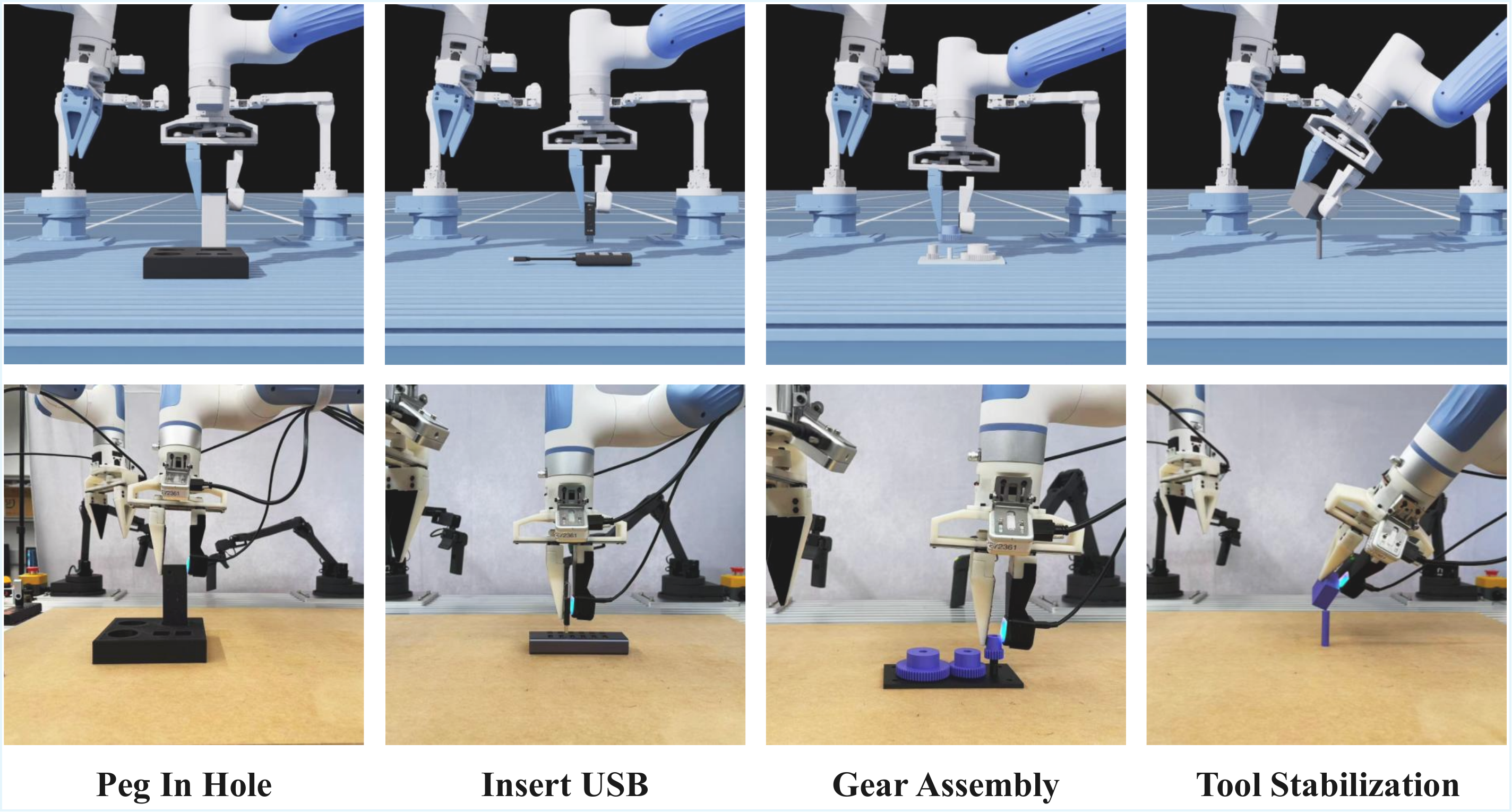
We evaluate DreamTacVLA on four tasks demanding precise, contact-rich manipulation — tight tolerances, slip detection, and stable tool contact.

Drop video / GIF here assets/videos/peg_in_hole.mp4 or .gif
Task 1

Peg-in-Hole

Classic high-precision insertion. The port is partially occluded, forcing the policy to rely on tactile feedback for the final alignment.

Success: 95.0%
Drop video / GIF here assets/videos/usb_insert.mp4 or .gif
Task 2

USB Insertion

Inserting a USB-A plug into a port with sub-millimeter tolerances that are ambiguous from vision alone.

Success: 85.7%
Drop video / GIF here assets/videos/gear_assembly.mp4 or .gif
Task 3

Gear Assembly

Sliding a small gear onto a shaft. Requires aligning the gear's hole with the shaft — easily failed by misalignment.

Success: 81.1%
Drop video / GIF here assets/videos/tool_stabilize.mp4 or .gif
Task 4

Tool Stabilization

Grip a cube and use one of its vertices to support a thin vertical cylinder, maintaining its upright pose under small disturbances.

Success: 74.6%

Results

Real-world success rates over 100 trials per task (mean ± std across 3 runs).

Method Peg-in-Hole USB Insert Gear Assembly Tool Stabilize
ACT 35.2 ± 0.7 62.6 ± 0.5 22.4 ± 0.8 19.3 ± 0.6
Diffusion Policy 35.5 ± 0.9 56.3 ± 0.8 33.1 ± 0.7 30.4 ± 0.9
π0 48.7 ± 1.0 59.4 ± 0.9 45.2 ± 1.1 41.0 ± 0.8
ACT (w/ Tactile) 45.6 ± 0.3 63.1 ± 0.4 40.2 ± 0.2 39.1 ± 0.7
Ours (HSA only) 60.8 ± 0.9 63.7 ± 0.8 51.5 ± 1.0 42.9 ± 0.7
Ours (Dream only) 75.4 ± 0.8 75.2 ± 0.7 64.9 ± 0.6 68.5 ± 0.9
Ours (HSA & Dream) 95.0 ± 0.2 85.7 ± 0.6 81.1 ± 0.4 74.6 ± 0.5

Hybrid Tactile Dataset

Available on Hugging Face: michaelyeah7/dobot_xtrainer_tac_1107.

2M
Tactile frames
4
Manipulation tasks
9
Objects
80/20
Sim / Real split
Sim and real data examples
A high-fidelity digital twin generates the bulk of demonstrations, complemented by real-world rollouts.

BibTeX

@article{ye2025learning,
  title={Learning to Feel the Future: DreamTacVLA for Contact-Rich Manipulation},
  author={Ye, Guo and Zhang, Zexi and Zhao, Xu and Wu, Shang and Lu, Haoran and Lu, Shihan and Liu, Han},
  journal={arXiv preprint arXiv:2512.23864},
  year={2025}
}