Portrait of Guo Ye
Guo Ye
AI for ScienceLeading DREAM Brain, the AI scientist of Northwestern's DREAM Cloud LabAI × Biology × Robotics

I build AI scientists that design experiments, run them on lab robots, and improve themselves from every result.

I work where AI, biology and robotics meet. I lead DREAM Brain, the AI scientist of Northwestern's DREAM Cloud Lab for protein engineering, built for recursive self-improvement (RSI). Before that I built tactile robot foundation models and the systems that take robot learning from notebook to deployment.

DREAM BODY · LIVEdigital twin · biofoundry
● ot2.transfer 5 µL 3:E1 → 1:D2 · tip 7:E2   ● thermocycler.run_program 5 · 24 stages   ● sealer.seal 165 °C · 2.0 s
2026 · Science

Self-driving discovery

DREAM Brain: an AI scientist closing the design–build–test–learn loop in a real wet lab.

2025 · Embodiment

Robots that feel contact

DreamTacVLA: a vision-language-action model that predicts touch before it acts.

2021 → 2024 · Systems

Robot learning infrastructure

DOS and RoboFlow: how AI-enhanced robots get built, tested and deployed reliably.

Flagship · 2026 – now

DREAM Brain

A1 · AI × Biology × Robotics

An AI scientist is not a bigger model on the same data. It is a model trained on decisions.

Lab automation already moved execution to machines. Judgement did not move: why an experiment exists, which alternatives were rejected, what outcome was expected. That reasoning stays in someone's head and is gone after the round.

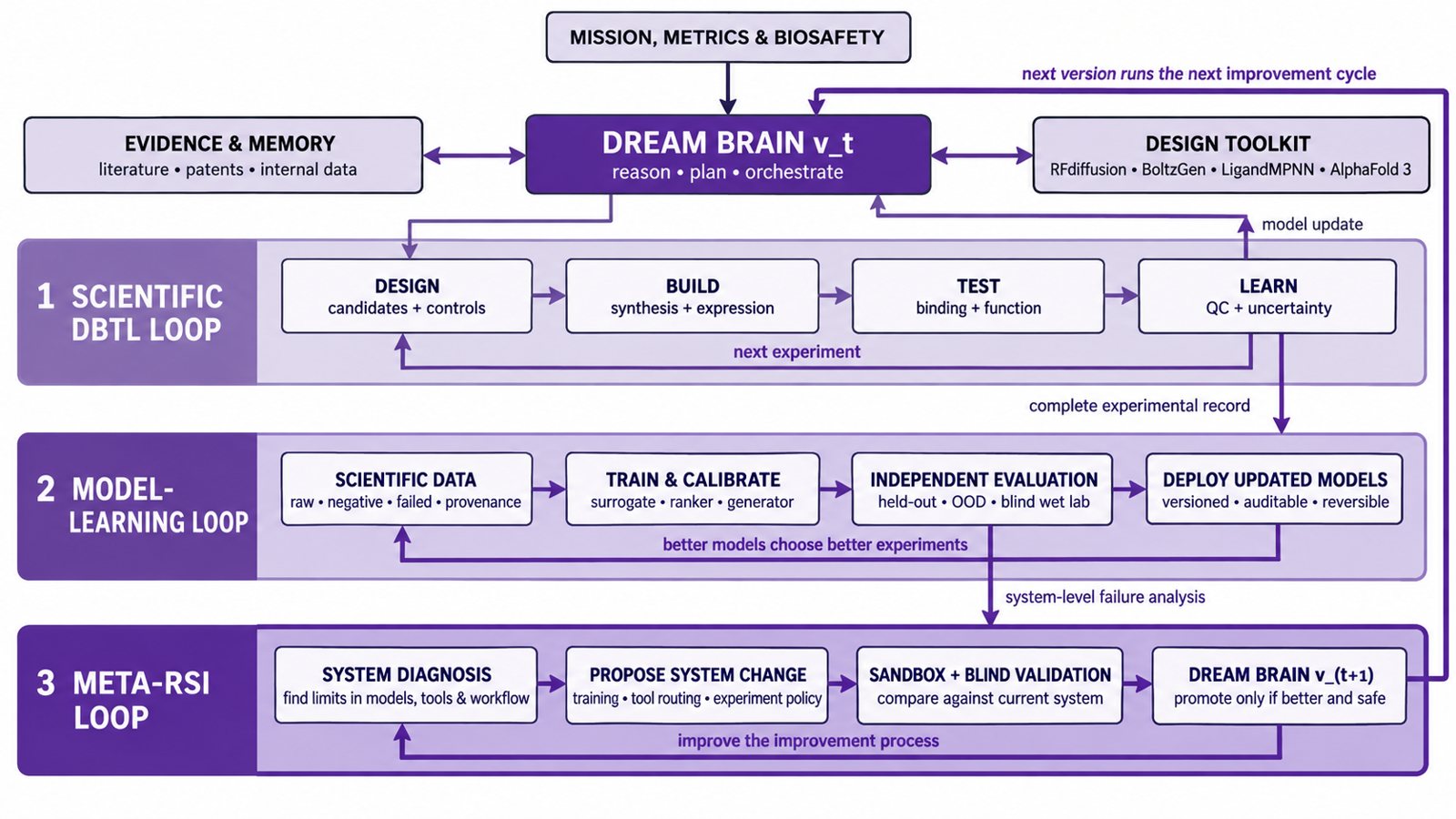
DREAM Brain is the intelligence layer that sits in the middle of the design–build–test–learn loop. It reads the literature, proposes protein designs, commits predictions before the plate goes in, drives the robots and instruments, and learns from the results. Every step is written down as Scientific Process Data, so the reasoning and outcome of every experiment become training data for the next, better version of the system. That recursive self-improvement (RSI) loop is the core of DREAM Brain.

Role
Lead architect of DREAM Brain; Data & AI for the DREAM Cloud Lab
Where
DREAM Cloud Lab for Protein Engineering, Northwestern Center for Synthetic Biology
With
Julius Lucks, Han Liu, Danielle Tullman-Ercek, Michael Jewett, and the DREAM science teams
Stack
LLM agents · SFT / GRPO post-training · AlphaFold 3 · RFdiffusion · LigandMPNN · BoltzGen · Opentrons / Echo / cell-free expression · digital twin
  1. 1

    Scientific DBTL loop

    Design candidates and controls, build by synthesis and cell-free expression, test binding and function, learn with QC and uncertainty. Improves the molecule.

  2. 2

    Model-learning loop

    Raw, negative and failed runs train and calibrate surrogates, rankers and generators, checked on held-out and blind wet-lab evaluation. Improves which experiment runs next.

  3. 3

    Meta loop · recursive self-improvement

    Diagnose where models, tools and workflow fail; propose a system change; sandbox it; promote the next DREAM Brain only if it is better and safe.

Diagram of three nested loops: scientific DBTL loop, model-learning loop and meta-RSI loop around DREAM Brain
Three nested loops. Each loop feeds a more complete record to the one above it.
Embodied AI · 2025

DreamTacVLA

B2 · Robotics

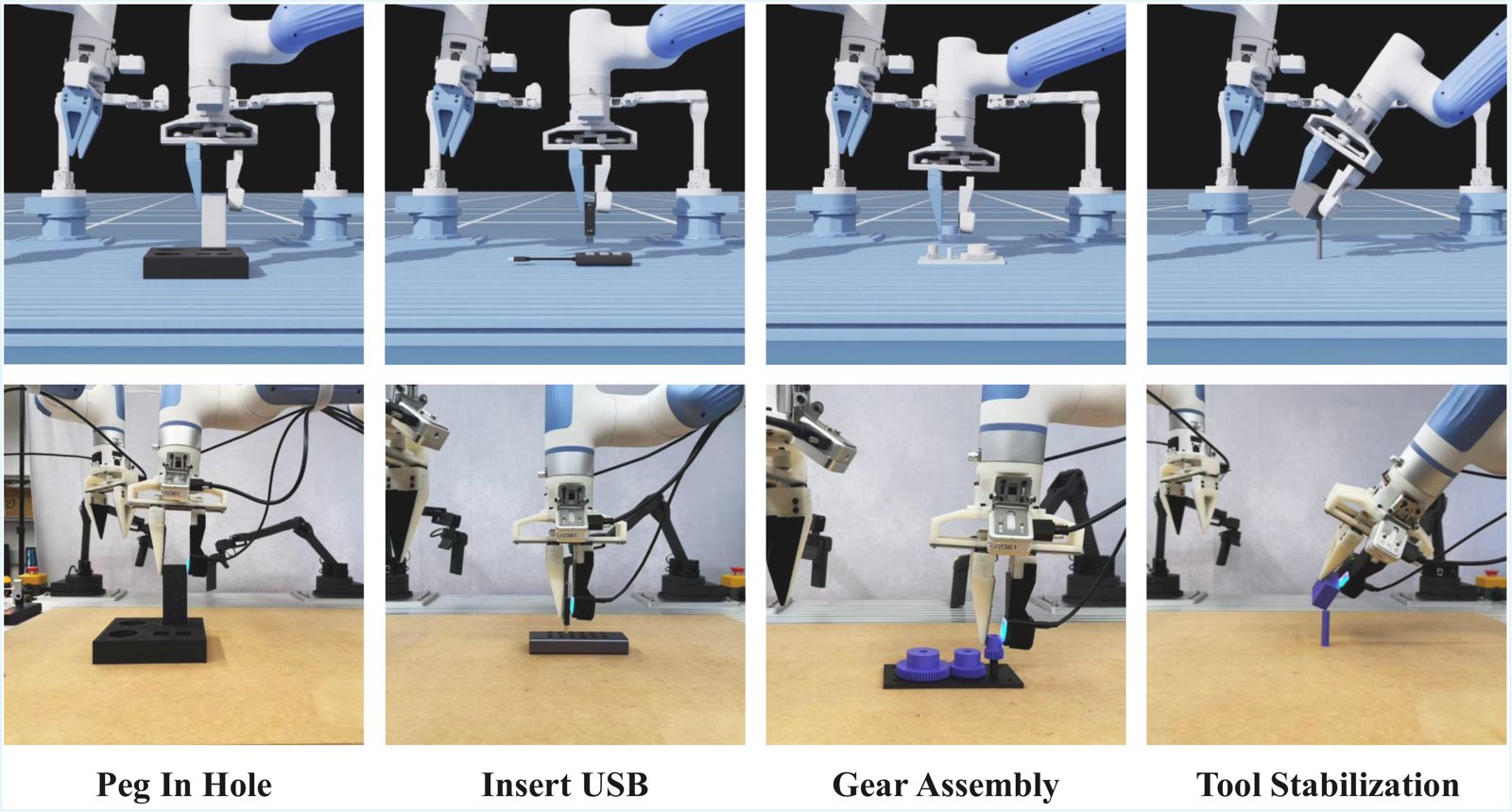
Vision-language-action models generalize well but cannot feel contact. DreamTacVLA gives a VLA high-resolution tactile images as a "micro-vision" stream, aligns them with what the cameras see, and adds a tactile world model. In a Think–Dream–Act loop the policy drafts an action, imagines its contact outcome, and refines the action before moving.

Guo Ye, Zexi Zhang, Xu Zhao, Shang Wu, Haoran Lu, Shihan Lu, Han Liu · Learning to Feel the Future: DreamTacVLA for Contact-Rich Manipulation

95%peak success on contact-rich tasks
+22.3%over tactile-alignment-only and dream-only ablations
2Mtactile frames; ~80% from a digital twin, 20% real
1.8%parameter overhead (5.5M adapter on a frozen ViT-L)
Real-robot rollouts. Peg-in-hole, USB insertion, gear assembly and tool stabilization, 100 trials per task.
Digital twin and real-world tactile demonstrations
Sim + real data. A high-fidelity digital twin generates most demonstrations, complemented by real-world rollouts.
Robot learning systems · 2021 – 2024

From notebook to deployed robot

C3 · Systems
ICRA 2024first author

DOS: A Deployment Operating System for Robots

Guo Ye, Qinjie Lin, Zening Luo, Han Liu

A CI/CD architecture for deploying data-driven robots reliably in the real world and in simulation. On a navigation robot facing many new corner cases, DOS cut deployment time and improved operational robustness over conventional pipelines.

Environment adapterabsorbs the mess of real deployment settings
Data replay reservoirone data model across different decision models
Analytical profileruser-defined metrics that drive optimization
CoRL 2021 · Blue Sky oralco-first author

RoboFlow: a Data-centric Workflow Management System for Developing AI-enhanced Robots

Qinjie Lin*, Guo Ye*, Jiayi Wang, Han Liu

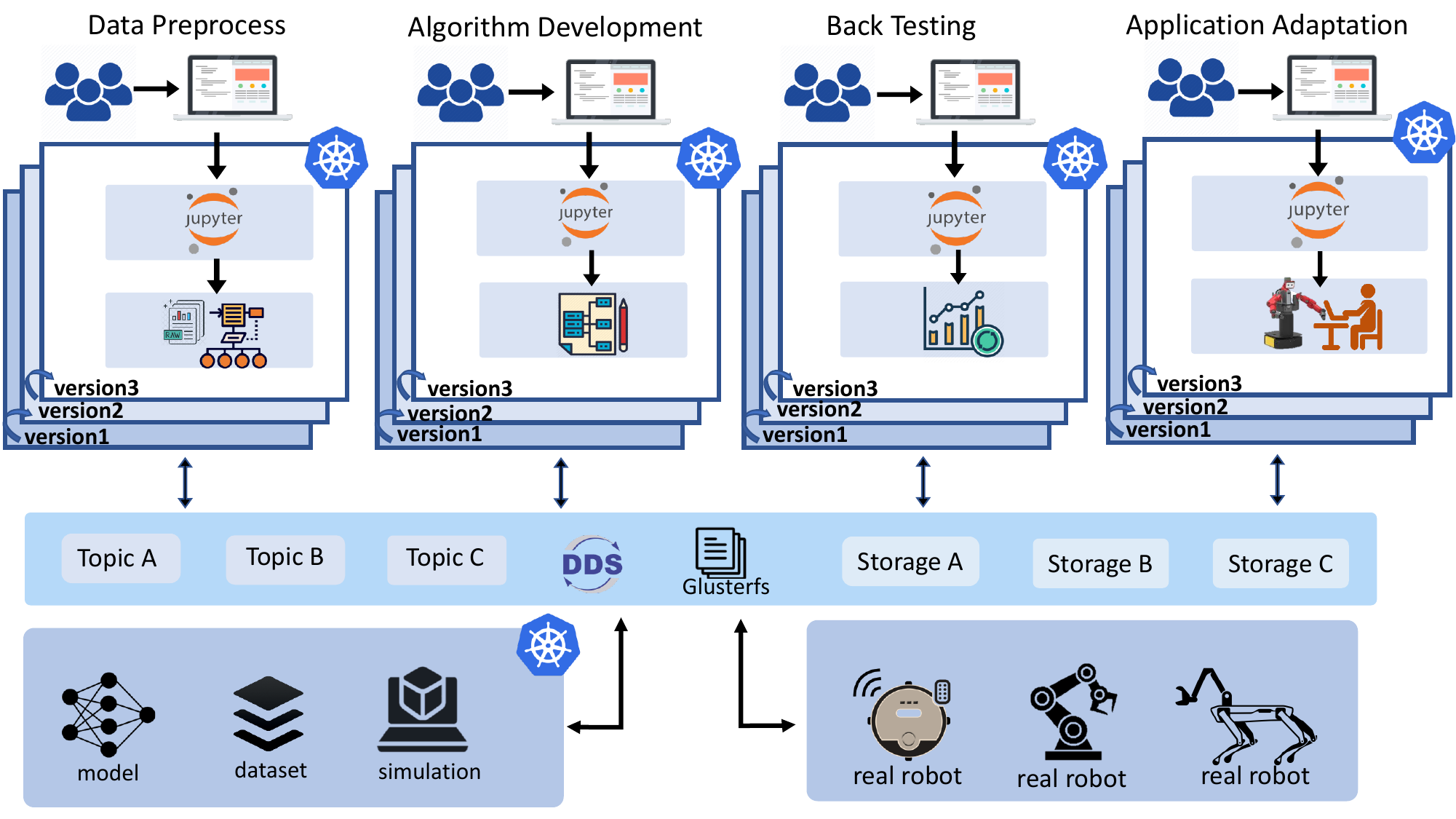
Versioned, containerized workflows that carry a robot from data preprocessing through algorithm development, back-testing and application on real hardware, over a shared data bus.

RoboFlow architecture: versioned stages for data preprocessing, algorithm development, back testing and application adaptation
About

One person across the whole loop

I'm a Data Scientist at the DREAM Cloud Lab, part of Northwestern's Center for Synthetic Biology, and hold a Ph.D. in Computer Science from Northwestern, advised by Han Liu. My training is in machine learning and robotics; over the last year I moved into molecular biology to build AI that does science, not just predicts it.

That mix is rare and it is the point. An AI scientist needs someone who can post-train the model, design the protein, write the robot protocol, and sit with the biologists to decide what the experiment should prove.

Agents & LLMs

Scientific agents and orchestrators, literature agents, benchmark design, SFT and GRPO post-training of open models.

Protein design

Co-folding and structure models, generative binder and sequence design, active learning over variant libraries.

Lab automation

Cell-free expression workflows, liquid-handling protocols, DNA order packages, digital twins of the biofoundry.

Robot learning

Vision-language-action models, tactile sensing, world models, sim-to-real with digital twins.

ML systems

Data-centric workflow management, CI/CD for robot deployment, experiment management at scale.